Author: BhaktiParv.com
Introduction
Among the principal deities of the Sanatan Dharma tradition, Vishnu Bhagwan stands as the cosmic preserver who maintains balance, order, and harmony across universal existence. He represents the sustaining force that supports creation, protects dharma, and guides humanity toward righteousness through divine avatāras. For thousands of years, the worship of Vishnu Bhagwan has shaped India’s spiritual identity, inspired sacred literature, and united diverse traditions under a singular philosophical framework grounded in preservation, compassion, and cosmic balance.
Vishnu Bhagwan is revered not merely as a divine being but as a metaphysical truth that upholds the universe. This embodiment of Satya (truth), Dharma (righteousness), and Karuna (compassion) manifests through values, scriptures, rituals, and incarnations, making his worship culturally powerful, spiritually transformative, and philosophically profound.
Table of Contents
1.Category
2.Vishnu Bhagwan in Sanatan Dharma
3.Iconography and Symbolism
4.Principle of Preservation
5.The Trinity and Cosmic Cycles
6.The Dashavatara Tradition
7.Vedantic Interpretations
8.Sacred Geography and Temples
9.Bhakti Traditions
10.Scriptures and Knowledge Systems
11.Festivals and Community Tradition
12.Cultural and Artistic Influence
13.Contemporary Significance
14.Final Thoughts
15.FAQ
Vishnu Bhagwan in Sanatan Dharma
In the Sanatan Dharma worldview, the universe functions through a delicate interplay of cosmic forces. Vishnu Bhagwan symbolizes the sustaining force that ensures continuity, balance, and protection. As the preserver, Vishnu maintains the order of cosmic law (Rita) and supports the ongoing manifestation of life.
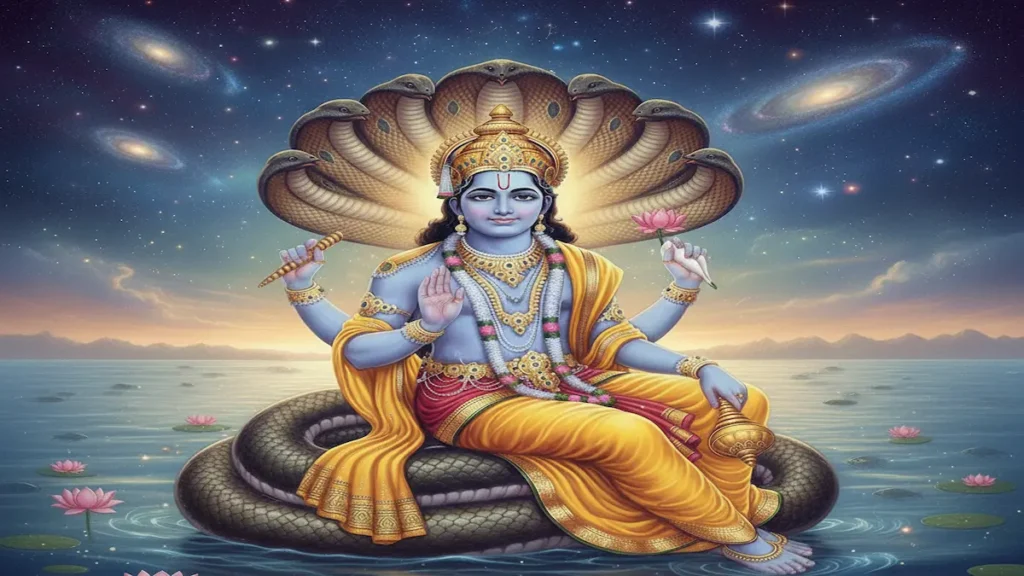
Vishnu Bhagwan is depicted as the eternal being who rests upon Sheshanaga in the Kshira Sagara (Ocean of Milk), signifying stability amidst universal fluidity. It is from this state of divine equilibrium that creation continues to thrive, and time flows in its infinite cycle.
Sanatan Dharma recognizes Vishnu Bhagwan as the divine foundation of dharma, the moral order underpinning human life, social conduct, and spiritual progression. The emphasis on preservation reflects not only cosmic continuity but also ethical guidance.
Iconography and Symbolism
The imagery associated with this deity carries deep philosophical and spiritual meaning. His four arms embody power and the ability to maintain balance across multiple planes of existence.
Each attribute conveys universal principles:
- Shankha (Conch) stands for cosmic sound and the origin of creation
- Chakra (Sudarshana) represents time, justice, and protection against chaos
- Gada (Kaumodaki) signifies strength and authority
- Padma (Lotus) symbolizes purity, transcendence, and spiritual growth
The serene deep-blue complexion reflects boundless cosmic space, illustrating the infinite nature of the divine.
Principle of Preservation
Preservation in Sanatan Dharma is not about mere continuity; it is the safeguarding of cosmic and moral order. The divine preserver protects dharma across spiritual, social, ecological, and philosophical dimensions.
This principle includes:
- Protecting the ethical fabric of society
- Restoring harmony when righteousness declines
- Supporting devotees against forces that disrupt balance
- Encouraging compassion among all beings
Preservation is therefore dynamic, ensuring that creation evolves rather than collapses.
The Trinity and Cosmic Cycles
Hindu metaphysical thought describes the universe moving through creation, preservation, and dissolution. Brahma initiates creation, Mahesh handles transformation and dissolution, while the preserver maintains continuity.
This trinity guarantees the eternal cycle of time, allowing life and consciousness to unfold within cosmic order.
The Dashavatara Tradition
One of the most significant aspects of this deity’s tradition is the Dashavatara—ten principal incarnations that appear during different eras to protect dharma. These include:
Matsya
Kurma
Varaha
Narasimha
Vamana
Parashurama
Rama
Krishna
Buddha
Kalki (yet to appear)
These incarnations illustrate divine intervention when injustice or imbalance threatens the world. They demonstrate that sustaining the universe requires action, not passivity.
Vedantic Interpretations
Vedanta explains the preserver as the supreme, formless Brahman who manifests attributes for the sake of existence and devotion. Philosophical schools such as Vishishtadvaita and Dvaita developed frameworks describing the relationship between the ultimate reality, the soul, and the universe.
In these teachings:
- The divine remains the highest reality
- Maya functions as the medium of manifestation
- The soul advances through devotion, duty, and righteous action
The Bhakti movement expanded these insights by aligning philosophy with devotional experience, making worship deeply intimate and accessible.
Sacred Geography and Temples
Shrines dedicated to this deity form an important part of India’s spiritual geography, preserving traditions of architecture, ritual, and culture. Many ancient temples continue to draw millions of pilgrims, including:
- Tirupati Balaji
- Badrinath
- Ranganathaswamy Temple
- Guruvayur
- Jagannath Mandir
- Dwarka
These centers highlight both spiritual devotion and historical continuity.
Bhakti Traditions
Devotional schools across India developed vibrant expressions centered around the preserver and his avatars, especially Rama and Krishna. Bhakti transcended linguistic and regional boundaries, shaping spiritual life through:
- Kirtan
- Mantra recitation
- Ritual worship
- Pilgrimage
- Service (Seva)
This devotional approach fosters intimacy with the divine while reinforcing ethical and spiritual discipline.
Scriptures and Knowledge Systems
The presence of the preserver is expressed through sacred literature including the Itihasas, Puranas, Upanishads, and Agamas. The Ramayana and Mahabharata narrate incarnations through epic stories of valor, sacrifice, and dharma.
The Vishnu Purana and Bhagavata Purana explore cosmology, devotion, and philosophical teachings that continue to influence Sanatan thought.
Festivals and Community Tradition
Multiple festivals honor the preserver and his avatāras, including Ram Navami, Janmashtami, Narasimha Jayanti, Vaikuntha Ekadashi, and Vamana Jayanti. These celebrations reinforce spiritual unity and cultural heritage.
Cultural and Artistic Influence
This deity’s influence extends across classical dance, music, literature, sculpture, and temple art. The Bhakti movement produced enduring devotional poetry, while classical dance preserved avatāra narratives through expressive performance.
Contemporary Significance
The principle of preservation remains relevant in discussions of ecology, morality, social harmony, and spiritual well-being. In an age of rapid change, the emphasis on dharma provides guidance rooted in timeless wisdom.
Final Thoughts
Vishnu Bhagwan represents the sustaining principle of the cosmos, ensuring continuity, balance, and protection across time. His presence in scriptures, philosophy, art, and devotion reflects the depth of India’s civilizational heritage. As the preserver of dharma, Vishnu Bhagwan stands as an eternal symbol of righteousness and compassion, guiding humanity toward spiritual and ethical evolution.
FAQ
Vishnu Bhagwan as the cosmic preserver
Vishnu Bhagwan safeguards universal order through preservation and protection of dharma.
Dashavatara and divine intervention
The Dashavatara illustrates how Vishnu Bhagwan restores balance across different eras.
Bhakti traditions and devotion to Vishnu Bhagwan
Devotion emphasizes surrender, service, and righteous living rooted in dharma.
Scriptural significance of Vishnu Bhagwan
Puranas, epics, and Vedantic texts elaborate his cosmic role and philosophical depth.
Category: Vishnu Bhagwan | Hindu Gods | Sanatan Dharma